
New learner guides and assessment tools change the way people work. Trainers need to understand how the materials are sequenced, assessors need to apply new benchmarks consistently, and everyone needs to know the rules on contextualisation, reasonable adjustment and the use of artificial intelligence. When that preparation is skipped, even well-written resources are used inconsistently, and inconsistency is exactly what validation and audit sampling tend to find.
This article sets out how to plan professional development around a resource change, what the Standards for RTOs 2025 say about continuing professional development, and how to keep a record that shows the development happened and made a difference.
What the Standards say about professional development
Two parts of the Outcome Standards deal with professional development directly.
- Standard 3.1 requires an RTO to facilitate access to continuing professional development so that staff can perform their roles effectively.
- Standard 3.2 requires an RTO to demonstrate how it ensures all trainers and assessors undertake continuing professional development to maintain current skills and knowledge in training and assessment, including skills and knowledge relating to engaging and supporting students.
Standard 3.3 separately requires trainers and assessors to maintain an understanding of current industry practice relevant to what they deliver.
ASQA’s practice guides give examples of how providers might show this. They mention internal or external courses, workshops, seminars and conferences, taking part in validation or moderation, mentoring, and professional development that builds AI literacy where it is relevant. They also list as a known risk providing professional development “on an ad-hoc basis” without considering whether it suits current and emerging practice. The workforce guide suggests a professional development framework, allocated time and regular reviews of whether the development offered is enough for people to do their jobs. These examples are guidance rather than requirements, and ASQA says its practice guides must be read alongside the legislation.
A resource change is one of the clearest triggers for planned, relevant development. It has a specific purpose, a defined group of staff and a date by which they need to be ready.
Step 1: work out what is actually changing
Before booking any sessions, compare the new materials with what your team uses now. Ask:
- Has the training product itself changed, or only the resources?
- Are there new assessment methods, such as structured observation, workplace projects or portfolios?
- Do the benchmarks or decision rules differ from what assessors are used to?
- Is delivery moving between modes, for example from classroom to online or blended?
- Are there new instructions about AI use, authentication or reasonable adjustment?
- Will the materials sit in a learning management system your staff have not used before?
The answers tell you who needs what. A trainer who will deliver the same unit with a better learner guide needs a briefing. An assessor moving to observation-based assessment with new benchmarks needs practice and calibration.
Step 2: match the development to the gap
Different gaps call for different kinds of development.
| Gap | Suitable development |
|---|---|
| Understanding the structure of the new materials | A walk-through session led by whoever reviewed the tools before use |
| Applying new benchmarks consistently | A calibration workshop where assessors mark the same sample responses and compare decisions |
| New assessment methods | Practice with the tools in a simulated or real setting, followed by a moderation discussion |
| Contextualising for a cohort | A working session with an industry representative or experienced trainer to adapt scenarios |
| Online delivery or a new learning platform | Hands-on training in the platform using a test course |
| AI use in assessment | A session on recognising inappropriate AI use and applying consistent rules to AI-supported evidence, an area ASQA’s guidance specifically mentions |
| Current industry practice | Industry placement, conference attendance or a briefing from an employer partner |
Calibration deserves particular attention. ASQA’s guidance on reliability describes assessment systems that give assessors enough context and guidance to make consistent decisions, and monitoring the consistency of assessor decisions over time. A short calibration session before first use is one of the most practical ways to start that.
Step 3: time it with the rollout
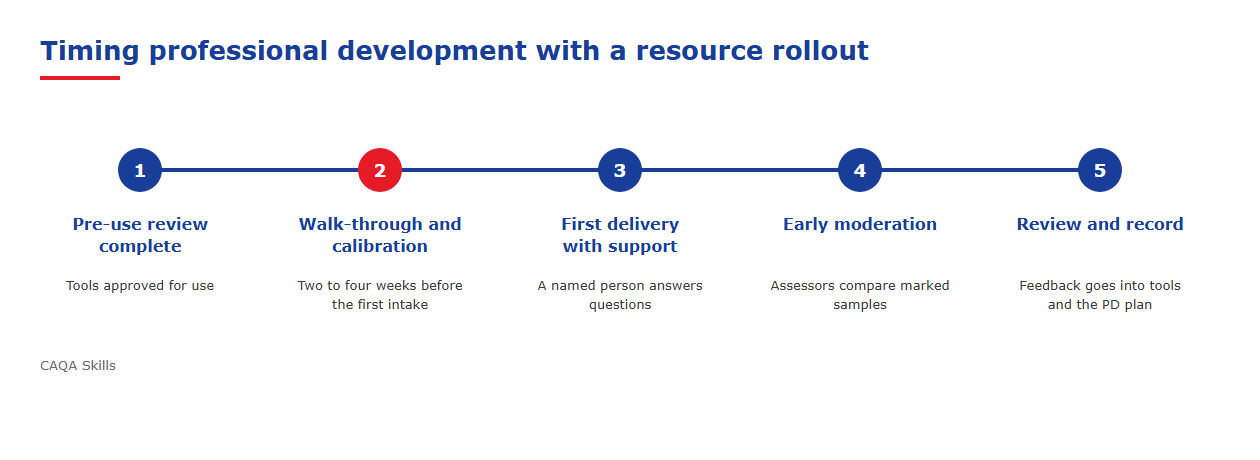
Development that happens months before the materials are used is easily forgotten. Development that happens after the first cohort starts leaves early students exposed to inconsistent practice. A workable sequence:
- Pre-use review complete. The tools have been reviewed and approved for use, as Standard 1.3 requires.
- Walk-through and calibration. Two to four weeks before the first intake, trainers and assessors work through the materials and calibrate on benchmarks.
- First delivery with support. A named person answers questions during the first weeks.
- Early moderation. After the first assessments are marked, assessors moderate a sample together.
- Review. Feedback from the moderation goes back into the tools and into the next round of development.
Step 4: record it so it counts
A professional development record should show more than attendance. For each activity, record:
- the date, duration and format
- who delivered it and who took part
- what it covered, linked to the specific resources and units involved
- what participants are expected to do differently
- any follow-up, such as moderation results that show whether practice became more consistent
Linking development records to the resource change, the pre-use review and later validation results gives a joined-up picture. It shows the development was planned for a reason, and it helps you judge whether it worked.
Illustrative example (hypothetical): a provider replaces the assessment tools for a community services qualification. The pre-use review notes that the new observation checklists use detailed benchmarks. The training manager schedules a calibration workshop where six assessors mark three recorded role plays. Their first decisions differ on two benchmarks, so the group agrees how to apply them and the assessor guide is clarified. The PD record links the workshop to the review, and the moderation after the first cohort shows the two benchmarks are now applied consistently.
Step 5: build it into your annual plan
Resource changes are not one-off events. Training products are updated, industry practice moves and new staff join. Building resource-related development into your annual professional development plan means each change has a slot, a budget and an owner. It also answers ASQA’s concern about development that is ad hoc rather than planned.
Common mistakes to avoid
- Treating a briefing email as development. Sending the new kit to staff with a note to read it is not the same as walking through it together and agreeing how benchmarks apply.
- Developing trainers but not assessors. Where the same person does both, make sure the session covers assessment decisions, not only delivery.
- Forgetting sessional and third-party staff. Anyone who delivers or assesses with the new materials needs the same preparation, including staff of third parties who deliver on your behalf.
- Recording attendance only. Without a note of what was covered and what should change, the record does not show that development was relevant to the role.
- Stopping after the first cohort. Moderation results and student feedback from the first cohort show what the next round of development should cover.
How CAQA Skills can help
CAQA Skills provides professional development for people working in vocational education and training, CRICOS and higher education. Depending on what your team needs, you can use:
- live webinars and recordings of past sessions on training, assessment and compliance topics
- workshops for hands-on practice
- self-paced online courses with a certificate of completion
- development arranged for your organisation and your staff
If you are introducing new materials from CAQA Resources, CAQA Skills runs briefing and calibration sessions for your trainers and assessors.
For the review your tools need before first use, see CAQA’s guide to assessment tool reviews under the Standards for RTOs 2025.
Next step: explore upcoming webinars and workshops, or contact CAQA Skills to arrange development for your team.